Best IPTV USA: Smart Tips for Choosing the Right Service
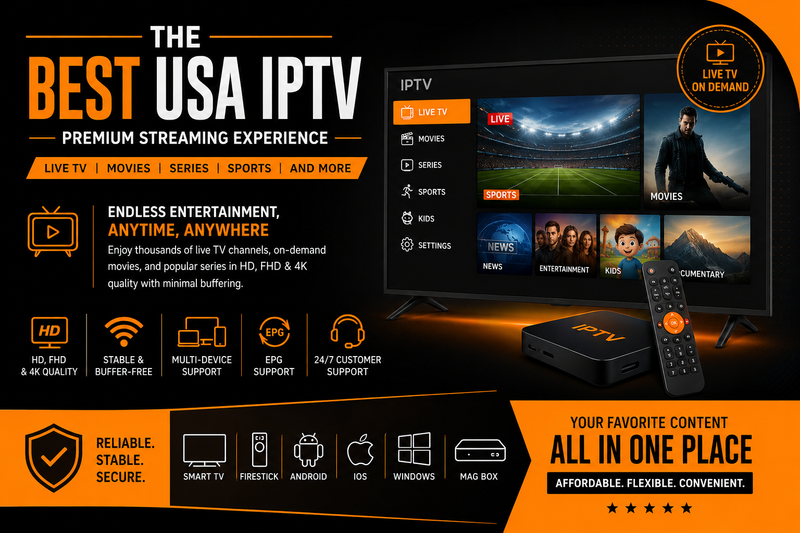
That freedom is useful, but it also creates a new problem: how do you know which service is actually worth paying for?
🚀 Start Your IPTV Journey
A search for the Best IPTV USA can bring up hundreds of websites making impressive promises. Some advertise huge channel selections. Others focus on low prices, high resolutions, multiple devices, or free trials. The problem is that marketing claims do not always tell you what the experience will be like once you start watching.
A good IPTV experience is not about having the biggest number printed on a sales page. It is about finding the right balance between content, reliability, picture quality, usability, price, and legitimate access.
This guide takes a closer look at what American viewers should consider before choosing an IPTV service in 2026.
💡 Find the Right IPTV Plan
IPTV Explained Without the Technical Jargon
IPTV stands for Internet Protocol Television.
In simple terms, it refers to delivering television programming through an IP network rather than relying exclusively on traditional broadcast, cable, or satellite delivery.
The concept is not particularly complicated from a viewer's perspective. You connect a compatible device to the internet, open the appropriate application or platform, sign into your account when required, and access the television content provided by the service.
Depending on the platform, that experience may include:
- Live television channels
- Movies and shows on demand
- Electronic program guides
- Catch-up programming
- Recording features
- Multiple supported devices
- High-definition or 4K content
- Personalized viewing options
But there is an important distinction that is often overlooked.
IPTV is a technology, not a guarantee of content quality or legality.
Two services can both use IPTV technology while offering completely different experiences. One may be a properly authorized service with professional support and dependable infrastructure. Another may make aggressive promises without providing enough information about where its content comes from.
That difference matters.
Why Finding the Best IPTV USA Option Can Be Difficult
The American television market is crowded.
Consumers already have access to cable companies, satellite providers, live-TV streaming services, network applications, free ad-supported platforms, and countless other internet entertainment options.
IPTV adds another category to that already busy landscape.
The difficulty is not finding a service. The difficulty is separating genuine value from impressive-sounding advertising.
A provider may claim to offer thousands of channels, but that does not tell you:
- How many channels are actually relevant to you
- Whether streams remain stable
- What quality the channels are delivered in
- Whether the service works on your device
- Whether the content is properly authorized
- How customer support responds to problems
- Whether the advertised price is the final price
Those are the details that matter once the excitement of a large channel list disappears.
Start With What You Actually Watch
Before comparing providers, forget about channel numbers for a moment.
Think about your own viewing habits.
If you mainly watch American news, sports, entertainment, and a few movie channels, you do not necessarily need an enormous international package.
If you share your television setup with family members, device support and simultaneous viewing may matter more.
If you travel frequently, mobile compatibility could become more important than an extensive electronic program guide.
If you are a serious sports viewer, stable live playback and low delay may matter more than having hundreds of channels that you will never open.
The best service is therefore different for different households.
Make a Personal Must-Have List
A useful approach is to divide your requirements into three groups.
Must have: content or features you cannot live without.
Nice to have: features that would improve your experience but are not essential.
Not important: things that sound impressive but would make little difference to you.
This simple exercise can prevent you from paying extra for features you will never use.
Channel Quantity Is Not the Whole Story
One of the most common IPTV marketing tactics is highlighting a massive channel count.
It is easy to understand why.
“Thousands of channels” sounds more impressive than “the channels you actually watch.”
But channel quantity can be a poor measurement of value.
Imagine two services.
The first claims to offer thousands of channels, but the selection is difficult to navigate and many channels are irrelevant or unreliable.
The second has a smaller catalog but provides the news, sports, entertainment, regional, and international programming you regularly watch.
Which one gives you more value?
Probably the second.
A good television service should make it easy to find useful content rather than forcing you to search through an enormous catalog simply because the number looks impressive.
Streaming Quality: What You Should Really Check
Picture quality is another area where advertising can be misleading.
You may see terms such as HD, Full HD, 4K, or Ultra HD. Those labels are useful, but they do not tell the entire story.
A high-resolution stream still needs to be delivered consistently.
If a 4K stream repeatedly buffers, drops quality, or disconnects, a stable HD stream may actually provide a better viewing experience.
When testing a service, look at:
- Image clarity
- Motion handling
- Buffering
- Audio synchronization
- Channel loading speed
- Quality changes during playback
- Stability during busy periods
Sports viewers should pay particular attention to motion and delay. Fast-moving content exposes weaknesses that may not be obvious when watching a slower television program.
How Much Internet Speed Do You Need?
Internet speed is important, but it is not the only factor behind good streaming.
For a rough starting point, many households can consider:
- 5 Mbps or more for basic lower-resolution streaming
- 10 Mbps or more for a comfortable HD stream
- 25 Mbps or more for higher-quality streaming and multiple connected devices
- More bandwidth for several simultaneous high-resolution streams
These numbers should not be treated as absolute requirements.
A household with fast internet can still experience buffering because of weak Wi-Fi, router problems, congestion, device limitations, or poor server performance.
On the other hand, a stable connection can often provide a smooth experience without requiring an unnecessarily expensive internet plan.
Your Home Network Matters Too
If the television is far from your router, Wi-Fi can become a weak point.
Walls, interference, network congestion, and older hardware can affect performance.
Where practical, Ethernet is worth considering for a fixed television or streaming box.
If you prefer Wi-Fi, place your router in a sensible location and avoid unnecessary network activity while watching high-bandwidth content.
The Difference Between a Good Stream and a Good Service
This distinction is easy to miss.
A service might deliver excellent video quality but still be frustrating because its application is poorly designed.
Another might have a clean interface but inconsistent streams.
A genuinely good service needs to perform well across several areas.
Reliability
The service should remain usable without frequent interruptions.
Navigation
Finding a channel or program should not feel like searching through a maze.
Guide Accuracy
An electronic program guide is only useful if its information is reasonably accurate and organized.
Support
When something goes wrong, you need a clear way to ask for help.
Compatibility
The service should work properly on the devices you intend to use.
Billing
The subscription process should be transparent and easy to understand.
These less glamorous details often determine whether you continue using a service after the first month.
Understanding IPTV Subscription Plans
An IPTV subscription can be structured in several ways.
Monthly plans are often useful for people trying a service for the first time. Longer plans may advertise a lower effective monthly price.
But a cheaper monthly equivalent does not automatically make an annual plan a better deal.
Consider the risk.
If you pay for one month and dislike the service, your loss is limited.
If you pay for an extended period and discover that the service does not meet your expectations, getting your money back may be much harder.
For unfamiliar providers, a short-term plan is often a sensible way to evaluate the real experience before making a longer commitment.
What About an IPTV Free Trial?
An IPTV free trial can be one of the most useful features a provider offers—provided the trial is legitimate and the terms are clear.
Do not waste the trial by watching one channel for two minutes.
Use it like a test drive.
Try your favorite channels.
Watch during different times of day.
Test your television and another device if possible.
Check whether the guide works.
See how quickly channels load.
And, importantly, contact customer support with a simple question.
A trial can reveal problems that promotional screenshots never will.
What to Check During a Trial
Pay attention to:
- Buffering frequency
- Channel loading time
- Video resolution
- Audio quality
- Guide accuracy
- Application responsiveness
- Device compatibility
- Customer support
- Subscription terms
If everything works smoothly, you have more evidence to justify a purchase.
If problems appear immediately, you have learned something valuable without committing to a long-term plan.
How to Evaluate the Best IPTV Providers
The phrase Best IPTV Providers is often used as though there is one universal ranking.
There isn't.
A provider that works well for one viewer may not be ideal for another.
Instead of relying completely on rankings, evaluate the provider itself.
Look for Transparency
A professional service should explain what it offers, how subscriptions work, and how customers can contact the company.
Look for:
- Clear pricing
- Terms and conditions
- Privacy information
- Support channels
- Device compatibility
- Refund and cancellation information
The more important information a company makes easy to find, the easier it is for consumers to make an informed decision.
Be Skeptical of Extreme Promises
If a service claims to offer virtually every premium channel, every major sporting event, enormous movie libraries, and premium picture quality for an unusually low price, stop and ask how that is possible.
Cheap does not automatically mean illegal or poor quality.
But unusually broad promises deserve closer examination.
Legal Considerations for IPTV in America
This is perhaps the most important part of the entire decision.
IPTV itself is not inherently illegal.
The issue is what content a service distributes and whether it has the necessary authorization to distribute that content.
Consumers should therefore investigate the provider rather than assuming that every service using IPTV technology has the same legal status.
A legitimate service should provide enough information for users to understand what they are subscribing to.
Avoid services that appear deliberately vague about their identity, content sources, business operation, or subscription terms.
Saving money is not worth exposing yourself to unnecessary legal, financial, or privacy risks.
Don't Confuse IPTV Players With IPTV Providers
Another common source of confusion is the difference between an IPTV player and an IPTV provider.
A player is generally an application used to play or organize compatible streams.
It may not supply the television content itself.
This means installing an IPTV player does not automatically give you legitimate access to television channels.
Before installing any application, consider its developer, privacy practices, supported platforms, and the source of the content you intend to watch.
Which Devices Should You Consider?
Your preferred device can influence the best choice.
A service might work beautifully on one platform and provide a less polished experience on another.
Common categories include:
- Smart TVs
- Android TV devices
- Apple TV
- Fire TV devices
- Streaming boxes
- Smartphones
- Tablets
- Laptops
- Desktop computers
- Web browsers
Always check official compatibility information before subscribing.
If your television is your primary viewing device, that should be the first platform you test.
Features That Are Actually Useful
Not every advertised feature deserves equal attention.
Some features genuinely improve everyday viewing.
Electronic Program Guide
A good EPG helps you understand what is playing now and what is coming next.
It is especially useful for live television.
Catch-Up Viewing
Catch-up features can be valuable when you miss a scheduled program.
Availability varies by service and by content.
Video on Demand
On-demand programming gives viewers control over when they watch.
Again, the quality of the library matters more than its advertised size.
Multiple Device Access
For households with several viewers, multiple-device support can be convenient.
However, check whether the subscription actually allows simultaneous streams rather than simply allowing the application to be installed on several devices.
Choosing IPTV for Sports
Sports can be one of the most demanding use cases for internet television.
A viewer may tolerate a small delay while watching a documentary, but a delayed or frozen sports stream can be extremely frustrating.
Sports viewers should therefore focus on:
- Stability
- Picture quality
- Motion clarity
- Stream delay
- Reliable channel availability
- Legitimate rights to the relevant sporting content
Do not assume that a provider advertising a sporting event necessarily has the authorization to distribute it.
Choosing IPTV for Families
Families have different priorities.
A good family-oriented setup should be simple to navigate and reliable enough that different household members can use it without constant troubleshooting.
Look for features such as:
- Easy menus
- Suitable content options
- Parental controls where available
- Multiple-device support
- Reliable playback
- Straightforward account management
The most technically impressive service is not always the easiest for an entire household to use.
Choosing IPTV for International Content
American households may also be interested in programming from other countries.
This can include news, entertainment, language-specific channels, and regional programming.
If international content is important to you, verify the exact channels rather than relying on a broad statement such as “global coverage.”
Channel availability can change, and legitimate distribution rights vary by region.
Common Warning Signs You Shouldn't Ignore
Some warning signs are obvious. Others are easy to overlook.
Be cautious if you encounter a provider that:
- Refuses to identify the business behind the service
- Offers unclear billing information
- Has no visible cancellation policy
- Promises unrealistic channel access
- Pressures customers into long subscriptions
- Provides little or no customer support
- Uses exaggerated claims about permanent availability
- Requests unusual payment arrangements without a clear explanation
- Gives vague answers about content authorization
None of these signs alone proves that a service is illegitimate.
Together, however, they should make you slow down before paying.
How to Compare IPTV Services Properly
Instead of creating a complicated scoring system, compare five core areas.
Content
Does the service offer what you actually watch?
Performance
Does it remain stable during normal viewing?
Compatibility
Does it work on your preferred devices?
Value
Is the price reasonable for the content and reliability you receive?
Trust
Does the provider clearly explain who it is, what it offers, how billing works, and where its content comes from?
If a provider performs well in all five areas, it deserves serious consideration.
Why the Cheapest Option Is Rarely the Best Strategy
Price matters.
Nobody wants to overpay for television.
But the cheapest subscription can become expensive if you spend your time troubleshooting streams, contacting support, switching applications, or replacing the service after a few weeks.
Think about the total value, not just the monthly number.
A service that costs slightly more but works reliably may deliver considerably more value over an entire year.
Likewise, a premium package may not be worthwhile if you only use a small portion of its content.
The goal is not to spend the least.
The goal is to spend intelligently.
Protecting Your Privacy While Streaming
Privacy should be part of your IPTV checklist.
Before opening an account, review the provider's privacy policy.
Pay attention to what information is collected and how the company says it uses that information.
You should also follow basic account-security practices:
- Use a strong password
- Avoid reusing passwords
- Keep your device software updated
- Download applications from trustworthy sources
- Avoid entering unnecessary personal information
- Review permissions requested by unfamiliar applications
A television subscription may seem harmless, but modern streaming platforms can still involve account, device, and usage data.
A Practical Buying Strategy for 2026
If you are currently searching for the Best IPTV USA, don't rush directly to the longest subscription.
Take a more measured approach.
First: Decide What You Need
Write down your must-have channels, preferred devices, desired picture quality, and budget.
Second: Research Several Providers
Do not compare only the first result you see.
Look at different options and compare their terms.
Third: Verify Compatibility
Make sure your primary television or streaming device is supported.
Fourth: Examine the Pricing
Check whether the advertised price is monthly, promotional, or subject to automatic renewal.
Fifth: Test Before Committing
If a legitimate free trial or short-term plan is available, use it.
Sixth: Evaluate the Experience
Watch your normal content rather than random channels.
Seventh: Decide Based on Value
Choose the service that gives you the best overall experience, not simply the biggest marketing number.
Final Thoughts
Finding the Best IPTV USA option is ultimately less about finding a magical provider and more about understanding what makes a television service genuinely useful.
The right choice should fit your viewing habits.
It should provide the channels you care about, work properly on your preferred devices, deliver stable streams, offer reasonable picture quality, and explain its subscription terms clearly.
A free trial can help you test the experience. A short-term subscription can reduce risk. A careful look at privacy and content authorization can help you avoid unnecessary problems.
Most importantly, don't let an enormous channel count make the decision for you.
A smaller, reliable, transparent service can be far more satisfying than a questionable package filled with channels you will never watch.
The smartest approach is simple: know what you want, test what you can, read the terms, and choose based on real value rather than advertising hype.
Frequently Asked Questions
What is the Best IPTV USA service?
There is no single service that is best for every American viewer. The right option depends on your preferred channels, devices, budget, streaming quality requirements, and the provider's reliability and content authorization.
Is IPTV the same as cable TV?
No. IPTV delivers television programming through an IP-based network, while traditional cable television uses cable infrastructure. IPTV can provide a more internet-focused viewing experience.
How fast should my internet be for IPTV?
Around 10 Mbps can be a practical starting point for one HD stream, while higher-quality streams and multiple simultaneous viewers may require considerably more bandwidth.
Does a free trial guarantee a good IPTV service?
No. A trial is useful for testing a provider, but you should use it carefully. Test your normal channels, devices, streaming times, picture quality, and customer support.
Is a yearly IPTV subscription better than monthly billing?
Not necessarily. A yearly plan may reduce the effective monthly cost, but monthly billing gives you greater flexibility when trying an unfamiliar service.
Can IPTV work on a Smart TV?
Many IPTV and internet television platforms support Smart TVs, but compatibility varies. Always check the official supported-device information before purchasing.
Why does my IPTV keep buffering?
Buffering can come from weak Wi-Fi, insufficient bandwidth, network congestion, device limitations, application problems, or the provider's infrastructure. Testing another service can help identify the source.
Is IPTV legal in the USA?
IPTV technology itself is legal. The key issue is whether the particular service has authorization to distribute the television content it provides.
Are more channels always better?
No. Channel relevance and reliability are usually more important than the total number advertised.
What should I check before buying an IPTV subscription?
Check the content you need, supported devices, price, renewal terms, cancellation policy, customer support, privacy information, streaming quality, and whether the provider is authorized to distribute its content.
